
Johannesburg weather and what to wear
Johannesburg is mild in the day almost all year, but winter nights are cold and summer brings rain and thunderstorms. Layers matter more here than a heavy coat.
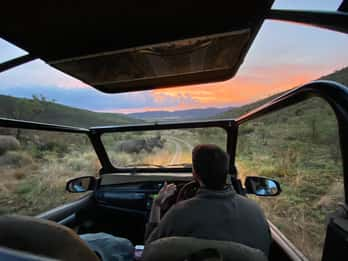
Pilanesberg day safari with two game drives
Full day, 2 open-vehicle game drives · About 12 hours
✓ Free cancellation
from R 2,995
Book on GetYourGuide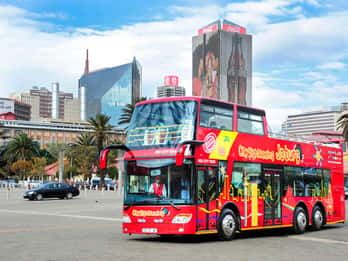
Hop-on hop-off bus with optional Soweto tour
1 or 2-day bus ticket, optional Soweto walk · 1 or 2 days; the full bus loop takes at least 3 hours
✓ Free cancellation
from R 425
Book on GetYourGuide
The weather in Johannesburg follows two rules. The city lies high on the Highveld, at about 1,700 m, which the South African government says keeps average summer temperatures below 30 °C. And almost all of its rain falls in summer, from October to March, while the winter from May to August is dry and clear. The figures below are long-term monthly averages from the South African Weather Service, measured near O.R. Tambo Airport.
Month by month
| Month | Average high | Average low | Rain | Rainy days |
|---|---|---|---|---|
| January | 25.6 °C | 14.7 °C | 125 mm | 16 |
| February | 25.1 °C | 14.1 °C | 90 mm | 11 |
| March | 24.0 °C | 13.1 °C | 91 mm | 12 |
| April | 21.1 °C | 10.3 °C | 54 mm | 9 |
| May | 18.9 °C | 7.2 °C | 13 mm | 3 |
| June | 16.0 °C | 4.1 °C | 9 mm | 2 |
| July | 16.7 °C | 4.1 °C | 4 mm | 1 |
| August | 19.4 °C | 6.2 °C | 6 mm | 2 |
| September | 22.8 °C | 9.3 °C | 27 mm | 4 |
| October | 23.8 °C | 11.2 °C | 72 mm | 10 |
| November | 24.2 °C | 12.7 °C | 117 mm | 15 |
| December | 25.2 °C | 13.9 °C | 105 mm | 15 |
A rainy day here means at least 0.1 mm, so many of them bring only a short shower. The averages cover the years 1961 to 1990.
Winter, May to August
The difference between day and night is the thing to pack for. A June day reaches about 16 °C on average, and the night falls to about 4 °C. The government notes that winter nights can reach freezing point in some places, so a warm jacket, a jumper and long trousers belong in the bag, even if you spend the afternoon in a T-shirt. Rain is rare, and the sky is usually clear.
Early starts feel colder than the numbers suggest. The Pilanesberg day safari collects guests between 06:00 and 06:30 and drives in an open vehicle, and its operator asks guests to bring a jumper for the drive and light clothes for the heat of the day. The same applies to balloon flights, which South African Tourism says almost always start before sunrise.
Summer, October to March
Summer days are warm, usually 24 to 26 °C, and the evenings stay mild. From November to January, rain falls on about half of the days. Thunderstorms can be heavy: in March 2026 the South African Weather Service warned of severe storms in northern Gauteng with local flooding, damage and power disruptions. Pack a light rain jacket or an umbrella and shoes that cope with wet streets, and keep an eye on the weather warnings before long drives.
Walking tours in Soweto and Maboneng run rain or shine, according to their operators, who ask guests to bring sun protection or rain gear and, in winter, layers. Comfortable walking shoes matter on all of them. For the cave visit at Sterkfontein in the Cradle of Humankind, flat shoes with grip are better than sandals, as the tour has many stairs.
In the city and on the bus
The hop-on hop-off bus is an open-top double-decker, so the upper deck is exposed to sun, wind and rain. A hat and sunscreen help in summer, and a warm layer in the morning in winter; the full loop takes at least three hours. For what to keep in your pockets, and what to leave in the hotel, see is Johannesburg safe.
For a safari
SANParks describes the summer from October as hot and rainy, and the winter from April to September as warm and dry by day with cold nights. Pack a hat for the day and a warm layer for drives in the open vehicle in the morning and evening. Kruger is a malaria area, and the National Institute for Communicable Diseases advises insect repellent with DEET, covering your skin after dark and sleeping under nets; ask a doctor about tablets before you travel. Pilanesberg, closer to Johannesburg, is described as malaria-free. One Kruger operator also reminds guests to bring their passport. More on the Kruger safari page.

Plugs, power and time
South Africa runs on 220/230 V at 50 Hz. According to South African Tourism, most plugs are 15-amp three-prong or 5-amp two-prong, both with round pins, so bring an adapter or buy one locally. The country uses GMT+2 all year without daylight saving time, which is one hour ahead of Central European winter time and the same as Central European summer time.
Planned power cuts, called load shedding, were a fixture for years. In March 2026 the government reported 300 days without them, but the UK Foreign Office notes that they can still happen and affect accommodation, ATMs, traffic lights and security systems. A power bank and a small torch take up little room.
All tours side by side
Outings where the weather and your clothing matter most: open-top buses in the city and open safari vehicles in the bush.
| Tour | Format | Duration | Age | Rating | From |
|---|---|---|---|---|---|
| Pilanesberg day safari with two game drivesMoAfrika ToursAfter pickup between 6 and 6:30 am, a guide takes you on a morning and an afternoon drive in an open vehicle, with a light lunch at the Pilanesberg Centre in between. | Full day, 2 open-vehicle game drivesPickup and drop-off in Johannesburg, two open-vehicle game drives, light lunch; park conservation fee not included, paid at the gate | About 12 hoursPickup in Johannesburg or Pretoria | Not for children under 4; children up to 5 need a private tour | 4.8 (1,650 reviews) | From R 2,995Free cancellationBook on GetYourGuide |
| Hop-on hop-off bus with optional Soweto tourCity Sightseeing South AfricaOpen-top double-decker buses run two routes with stops such as Melrose Arch, Constitution Hill, the Apartheid Museum and Gold Reef City, with audio commentary in eight languages and an optional two-hour Soweto walk. | 1 or 2-day bus ticket, optional Soweto walkAudio commentary in 8 languages, live bus tracking, Wi-Fi, map, headsets, shuttle from selected Sandton hotels, Soweto walk if chosen; entrance fees not included | 1 or 2 days; the full bus loop takes at least 3 hoursCity Sightseeing office, The Zone mall, Oxford Road, Rosebank | – | 4.7 (1,228 reviews) | From R 425Free cancellationBook on GetYourGuide |
| Three-day Kruger safari with a lodge in HazyviewAfrica Moja Tours & SafarisTravelling via Elands Valley and Nelspruit, the tour combines morning and afternoon drives in an open vehicle in Kruger, with the first night at Tembo Guest Lodge in Hazyview. | 3 days, 2 nights, bungalow or chaletPickup and drop-off at hotels and Johannesburg Airport, national park and game drive fees, bungalow or chalet; food and drinks only where stated | 3 daysPickup in Johannesburg, Pretoria, Centurion, Midrand, Sandton or East Rand | Not suitable for pregnant travellers; malaria risk mainly February to May | 4.7 (137 reviews) | From R 13,252Free cancellationBook on GetYourGuide |
Prices and ratings come from the booking platform and are shown per person. If you book through these links we earn a commission. Your price stays the same. Sorted by number of reviews.
Questions travellers ask
How cold does Johannesburg get in winter?
In June and July the average low is 4.1 °C, and the South African government notes that nights can fall to freezing point or below in some places. Days are mild, with average highs of 16 to 17 °C.
Does it rain a lot in Johannesburg?
Mostly in summer. From October to March the city gets more than four fifths of its yearly rain of about 713 mm. From May to August there are only one to three rainy days a month on average.
What should I wear on a game drive?
Layers. Morning drives start early in an open vehicle, and operators ask guests to bring a jumper even when the day turns hot. In Kruger, cover your skin after dark and use insect repellent, as the park is a malaria area.
What plugs are used in South Africa?
South African Tourism says most plugs are 15-amp three-prong or 5-amp two-prong, both with round pins, on a 220/230 V, 50 Hz supply. Bring an adapter or buy one locally.
Do I need to bring a torch because of power cuts?
Planned power cuts, known as load shedding, have been rare since 2025, but the UK government says they can still happen and affect accommodation, ATMs and traffic lights. A small torch or phone light is useful.
Where these facts come from
Dates, opening hours and rules change. We checked these pages in November 2026; the official source has the final word.
- WMO World Weather Information Service: Johannesburg (data from the South African Weather Service)
- South African Government: Geography and climate
- SAnews: SAWS warns of severe thunderstorms in Gauteng, Mpumalanga
- SANParks: Kruger climate
- SANParks: Kruger vital information
- SABC News: Malaria cases expected to rise over Easter, NICD warns
- South African Tourism: Hot-air ballooning in South Africa
- South African Tourism: Electricity in South Africa
- South African Government: South Africa at a glance
- GOV.UK: South Africa travel advice, safety and security
- South African Government: Eskom marks 300 days without loadshedding (13 March 2026)
- Tour pages on GetYourGuide, checked 8 November 2026


